
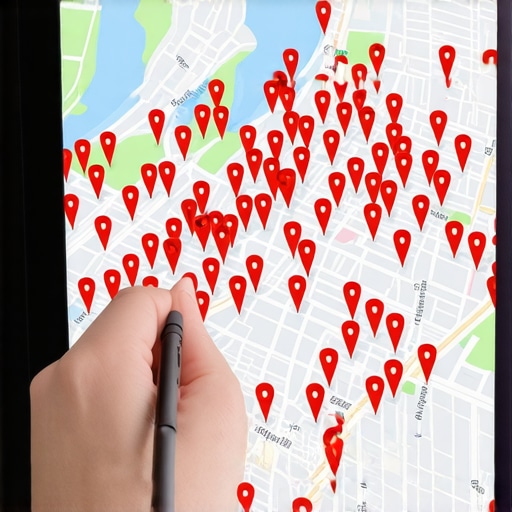
The Tactics That Actually Clean Up Map Spam in High-Competition Niches
Map spam is a spatial logistics failure that corrupts the efficiency of local discovery systems. As a logistics manager who views Google Maps as a dispatch engine, I see a business listing as a proximity beacon. When fake addresses or keyword-stuffed names enter the database, they create friction in the routing of customers. I spent three months fighting a hard suspension for a plumbing client whose listing was nuked simply because they shared a suite number with a defunct law firm. Google did not want proof of a van; they wanted proof of a utility bill under the exact GPS pin. This level of forensic scrutiny is the new baseline for survival in high-competition markets. You must treat your location data as a delivery manifest where every coordinate is a high-stakes asset. If your data drifts, your lead flow stops.
The ghost in the GPS coordinates
GPS coordinate salience is the microscopic foundation of every local ranking signal in modern search. Every time a user triggers a query, the algorithm calculates the distance between the user device and the business centroid. This is not just about a street name; it is about the latitude and longitude stored in the underlying spatial index. If your pin is even ten meters off the entrance of your building, you lose relevance. Many shops face a sudden rank drop because they have not looked at the invisible errors killing leads. This is why fixing a drifting map pin is the first step in any cleanup operation. You are fighting for fractional centimeters of relevance. The algorithm maps the frequency of user devices stopping at your exact coordinates to verify you actually exist. If the math does not add up, your profile is filtered out of the results.
Why your physical address is a liability
A physical address is often a liability when it lacks the unique infrastructure of a stand-alone location. Shared offices and virtual suites are the primary targets of the current spam-fighting AI. Google prefers clear, unambiguous proof of occupancy that excludes other businesses. If you operate from a shared space, you must know how to rank safely while operating from a coworking space. The system looks for conflicting data points across the web. This is why coworking offices often fail to rank in competitive sectors like legal or locksmithing. You need to provide the algorithm with distinct signals that separate your operations from the noise of the building. This involves more than just a suite number; it requires a unique phone line and specific doorway photos that prove your presence. Without these, you are just another ghost in the machine.
“Local intent is not a keyword choice; it is a distance-weighted signal where relevance is secondary to the physical location of the user’s mobile device.” – Map Search Fundamental
The three mile radius that determines your revenue
Proximity is the most powerful filter in the Google Business Profile ecosystem today. Most service businesses believe they can rank across an entire city, but the reality is dictated by a three-mile radius around the primary centroid. As you move further from the physical pin, your visibility decays exponentially. This is the vicinity effect. To combat this, you need a top google business profile seo toolkit to map out exactly where your visibility drops off. If you are trying to unlock local map visibility, you must focus on the hyper-local signals. This includes localized content on your website that mentions specific intersections or neighborhood landmarks. The goal is to prove to the algorithm that you are the most relevant option for that specific pocket of the city. Most agencies fail because they try to spread the authority too thin. You must win your block before you can win the city.
The logistics of a reinstatement war
Reinstating a suspended profile is a forensic audit of your entire business existence. When a listing is nuked, the burden of proof is entirely on the business owner. You are not just filing an appeal; you are presenting a legal-grade dossier to a skeptical investigator. You must prove your business is real when verification fails by using high-resolution video and government documents. I have seen profiles restored simply because we provided a video of the owner unlocking the front door and showing the business license on the wall. This is where appealing to the high-level team becomes necessary. You cannot rely on automated systems to fix a manual action. You need a human reviewer to see the physical evidence of your operations. If your data is messy, you will fail. This is why clearing manual actions requires absolute precision in your documentation.
How the proximity filter kills legitimate growth
Growth is often throttled by the algorithmic filter that groups similar businesses together. If your office is located in a cluster with three other competitors, Google will often only show one. This is the duplicate filter in action. To stay visible, you must differentiate your profile through real engagement and superior metadata. You should look into beating the duplicate filter without triggering a suspension. This involves optimizing your categories and ensuring your website speed is not a bottleneck. In fact, page load times influence your map position more than most experts admit. A slow site is a signal of poor user experience, which leads the algorithm to favor your competitors. High-competition niches are won by the businesses that have the cleanest technical foundations.
Local Authority Reading List
- Multi-Location Success Toolkit
- Simple Local Audit Checklist
- Ranking Without Keyword Stuffing
- Fixing Manual Actions Permanently
The forensic truth about service area polygons
Service area businesses live and die by the polygons they define in their dashboard. Selecting a service area that is too wide is a common mistake that dilutes your relevance. If you claim to serve a fifty-mile radius but your reviews all come from a five-mile radius, the algorithm flags the discrepancy. You must maintain map stability while scaling service areas by backing up your claims with geo-tagged photos and local check-ins. When you expand to a new neighborhood, you need to build trust signals for that specific zone. This means getting reviews from customers in those new zip codes. The map is a living database of user movement. If no one from your claimed service area interacts with your profile, your ranking will vanish. The data must match the geography.
Why the map pack ignores your best keywords
Keywords are secondary to behavioral signals in the modern Map Pack. You can stuff your description with search terms, but it will not help if your profile lacks engagement. Google uses keyword stuffing detection to penalize profiles that try to game the system. Instead, focus on real engagement tactics that prove you are a legitimate local authority. The algorithm tracks things like click-to-call rates, request-for-quote frequency, and how many people ask for directions. These are the metrics that move the needle. If you need a gmb ranking toolkit buy to monitor these stats, do so with the understanding that the tool is only a mirror of your real-world performance. You cannot manufacture trust; you have to earn it through consistent service and clean data management.
“Relevance is the result of consistent behavioral patterns over time, not the density of strings in a database field.” – Location Intelligence Whitepaper
The math behind local review sentiment
Review sentiment is a mathematical weight that adjusts your ranking based on consumer trust. It is not just about the star rating; it is about the words used in the reviews. Google extracts entities from your reviews to understand what services you actually provide. If customers constantly mention your speed and reliability, those terms become part of your local justification triggers. This is why stabilizing rank after a review purge is so difficult. You lose the entity signals that were holding your position. To rebuild, you must rebuild trust signals by encouraging detailed feedback from your local clients. The algorithm is looking for a pattern of satisfaction that correlates with your physical location. It is a logic of social proof that serves as a proxy for quality.
Cleaning up the map pack from the inside
Cleaning up map spam requires a systematic removal of fraudulent competitors. In high-competition niches, the map is often cluttered with fake listings that use keyword-stuffed names. You must use the suggest an edit feature strategically to report these violations. If you are struggling with a sudden drop, you might need emergency seo services to identify the spam attacks. Often, a competitor will try to move your pin or change your hours. You must resolve conflicting business hours immediately to prevent a loss of authority. Monitoring your profile is a daily logistics task. You are the gatekeeper of your own data. If you allow errors to persist, the algorithm will assume you are no longer in business. Vigilance is the only way to maintain a top spot in the Map Pack. You have to be faster and more accurate than the spam.
{“@context”: “https://schema.org”, “@type”: “FAQPage”, “mainEntity”: [{“@type”: “Question”, “name”: “What is the most important factor for ranking in the Map Pack?”, “acceptedAnswer”: {“@type”: “Answer”, “text”: “Proximity to the user is the primary factor, but it must be supported by consistent NAP data and high-quality behavioral signals like clicks and directions requests.”}}, {“@type”: “Question”, “name”: “How do I fix a suspended Google Business Profile?”, “acceptedAnswer”: {“@type”: “Answer”, “text”: “You must perform a forensic audit of your business documents, including utility bills and licenses, and submit a detailed appeal with video evidence of your physical location.”}}, {“@type”: “Question”, “name”: “Does keyword stuffing the business name help?”, “acceptedAnswer”: {“@type”: “Answer”, “text”: “While it may provide a short-term boost, it is a high-risk violation of Google’s TOS that usually leads to a permanent suspension or a manual action cleanup process.”}}]}